
Fact File
Would you like to know more? Here we have compiled answers to frequently asked questions about battery energy storage systems.
If you still have questions, please contact us and we would be happy to help.
Frequently Asked Questions
1. What is a battery energy storage system?
A battery energy storage system is a collection of weatherised, container-like units that store electrical energy when it is available and release it when needed.
When the sun is shining or the wind is blowing, these sources generate electricity, but sometimes they produce more than we need at that moment, for example, when it is extremely windy or sunny.
At present Ireland does not have the infrastructure to store meaningful amounts of this excess energy. It ends up being wasted and then when it’s a very cloudy or calm day, we have to use fossil fuel for our energy generation.
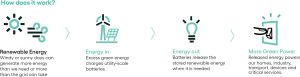
Instead of wasting that electricity, we can store it in a battery energy storage system and save it for later. Then, when we need electricity, such as at peak demand times in late afternoon or early evening, the battery system can release the stored energy to power our homes, industry, transport, devices and critical services.
Batteries can play a key role in increasing our use of renewable energy, which will make the electricity grid and our energy supply much more secure, reliable and cost-effective.
2. How does a battery storage system work?
Battery energy storage systems enable energy from renewable sources, such as solar and wind, to be stored and then released when the power is needed most.
3. Why do we need battery energy storage?
A number of challenges arise when attempting to deliver deeply decarbonised power systems based on variable renewable technologies such as wind and solar:
-
- Transmission network constraints: As we continue to build renewable energy projects, the electricity network can reach capacity at certain grid locations. This means that the renewable energy generators need to be turned down to prevent existing power lines becoming overloaded.
- System-wide curtailment: This can arise when there is so much power available from renewable generators that the system cannot accommodate it. Again, the generators need to be turned down and the power is wasted.
- Generation adequacy at times of low renewable output: When the wind isn’t blowing or the sun isn’t shining, the only alternative is to burn fossil fuels to generate power.
Storage technologies, particularly storage technologies with extremely large energy capacities, absorb excess renewable generation at times of high output and provide this energy back to the system at times of lower output.
If these technologies can be deployed at scale and in the right locations across Ireland, they have the potential to simultaneously solve the three problems noted above while also reducing our reliance on imported fossil fuels, lowering harmful carbon emissions and lessening our exposure to volatile fossil fuel prices.
Ireland is recognised as being a global leader in integrating variable renewable electricity on its power system. The International Energy Agency considers Ireland and Denmark to be two of the most advanced countries globally in this respect.
In 2025, the SEAI reported that Ireland met 41% of its annual electricity demand from renewable energy sources. Ireland’s stated national ambition for 2030 is to go much further, with a target to reach 80% of electricity from renewable sources2. In order to achieve this ambition, battery energy storage systems such as Lettermore will be crucial.
1 htps://www.iea.org/data-and-stascs/charts/countries-and-regions-in-phases-of-renewables-integraon-2019
2 htps://www.gov.ie/en/press-release/16421-climate-action-plan-2021-securing-our-future/
4. What are the benefits?
We need a reliable, clean, economic source of electricity to ensure that daily life runs smoothly.

Homes, hospitals, businesses, schools, public transport and water sanitation all rely heavily on a reliable electricity supply. Battery energy storage systems have the potential to support our energy needs by providing a consistent, home-produced, secure source of renewable electricity.
Community Benefit Fund: An annual fund based on the size (MW) of the project is designed to support local community initiatives. More details will be shared in the next newsletter.
Local economic boost: The construction phase creates jobs for skilled workers and contractors while supporting local suppliers and service providers.
County funding: Council rates payments. The county council receives substantial long-term revenue through rates, payments that support essential services such as road maintenance, public lighting and fire services.
Energy efficiency: Sometimes we have more wind energy available in a region than the electrical lines can carry, or more than the system demand requires. Battery energy storage systems provide this energy with a place to go, which stops potential green energy going to waste.
Environmental responsibility: By reducing the country’s reliance on fossil fuels, we contribute to the reduction of greenhouse gas emissions. This will help the Government reach its target of becoming carbon neutral by 2050.
Grid reliability: Storing excess energy ensures a consistent, reliable power supply. This capability helps the overall stability of our grid. This is critical to support our electrical infrastructure and Ireland’s increasing energy needs.
Stable energy costs: Energy storage systems help to stabilise electricity costs by optimising energy usage and reducing our dependence on expensive fossil fuel power generation.
Energy security: Battery energy storage systems reduce our reliance on fossil fuel imports and our economy’s exposure to geopolitical events such as the recent Middle East conflict, which led to energy supply challenges and significant increases in fuel bills.
5. What type of battery energy storage system are you proposing?
There are different technologies used in battery energy storage systems with the most widely used being lithium-ion.
FuturEnergy Ireland is working in partnership with Form Energy, a US company driving innovation in energy storage technology and manufacturing. Together, we are proposing to use an iron-air battery energy storage system This system is different from other technologies, and here’s why:
A multi-day storage system is capable of storing 100% clean electricity for up to 100 hours, compared with current batteries which can store electricity for four to six hours.
It is based on chemistry using iron, air and water. The components are made from these safe natural, and abundant materials
Each battery module contains a stack of many smaller, individual battery cells. Each cell is filled with iron and air electrodes, as well as water-based, non-flammable electrolyte, like the electrolyte used in AA batteries.
There is no pathway for thermal runaway (i.e. fire risk) with iron-air batteries that is a failure mechanism in other battery technologies.
Around 95% of materials used are recyclable or salvageable:
This type of battery system can provide reliability and resiliency in a highly renewable grid, delivering energy at low cost when the grid needs it most: during extended periods of extreme weather, grid outages, or low renewable generation.
6. A closer look at how iron-air batteries work
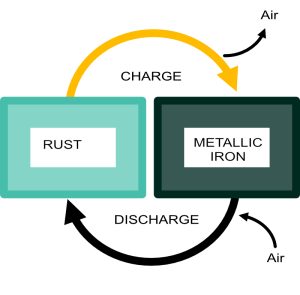
- The principle is reverse rusting.
- While discharging, the battery ‘breathes in’ oxygen from the air and converts iron metal to rust.
- While charging, the application of an electrical current converts the rust back to iron and the battery ‘breathes out’ oxygen.
- This cycle repeats, providing us with low-cost, stable, safe energy storage when and where it is needed.
7. What do battery energy storage systems look like?
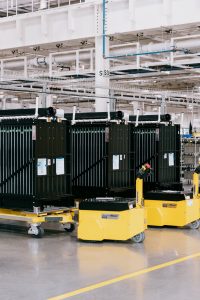
Iron-air batteries are housed in units that resemble shipping containers and installed on level concrete foundations. The containers are approximately 12 metres by 2.5 metres by 2.5 metres (see below for a Form Energy unit).
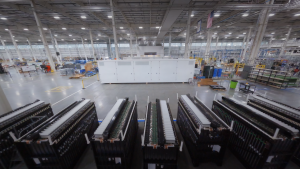
As part of the planning design, the project will be surrounded by enclosed palisade fencing and include landscaping and planting along site boundaries. A biodiversity plan to include planting for additional screening of the site will be designed specifically for the proposed Lettermore Energy Storage project.
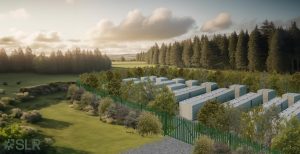
A computer-generated image of what a FuturEnergy Ireland project might look like.
8. Will I get to see what the project will look like before a planning application has been submitted??
Yes
Visual representations of the Lettermore energy storage project viewed from key locations will be available before a planning application is made. These will also be uploaded to the project website.
A comprehensive Visual Impact Assessment is being carried out, which is informed by realistic 3D photomontages.
This assessment considers views from nearby homes, public rights of way and sensitive natural areas. The impact depends on the scale of the site and local context. Lettermore Energy Storage is being designed to minimise its visual impact to the extent practicable on local communities.
Battery storage units are usually compact, low-rise, and designed to minimise contrast with the surroundings. As part of the design, the project would be surrounded by fencing. It is expected that the existing tree line would be kept to screen the project area complemented by landscaping and planting along site boundaries where appropriate.
If impacts are identified, mitigation measures are implemented. Common approaches include planting hedgerows and trees, installing earth mounds as screening, adding fencing, or adjusting the site layout and orientation to reduce visibility. These measures help to limit the overall visual impact and take the local environment into consideration.
The planning application will include a chapter on Landscape and Visual Impacts, which will also include photomontages. This will be available for you to view as part of a planning application once submitted and validated by the relevant planning authority.
9. How do you select sites to locate projects?
Batteries are usually located near substations or renewable energy projects, subject to environmental studies to rule out any areas of sensitivity. Specialists also assess site-specific factors, such as landscape, safety, and flood risk.
In the case of Lettermore, studies showed that the site was suitable. The Lettermore site is in close proximity to a substation, suitably separated from sensitive residential receptors. It is not on any Special Areas of Conservations (SAC) or Special Protection Areas (SPA) while conifer forestry would provide natural screening.
For Co Donegal in particular, the case for energy storage projects such as Lettermore is stronger than in many other parts of the country. The county has significant renewable energy capacity but a weak grid infrastructure, which makes it challenging to get electricity on to the grid when it is available. Battery storage can make the grid stronger, more reliable and more efficient.
10. What assessments are being carried out?
Lettermore Energy Storage is being designed in accordance with industry best practice guidance and regulations.
The team is preparing a comprehensive Planning & Environmental Report in support of the planning application and an Appropriate Assessment Screening (or Natura Impact Statement, if deemed necessary).
The Planning & Environmental Report considers the following areas
-
- Planning Policy
- EIA Screening
- Land, Soils, Geology and Hydrogeology
- Hydrology/ Water Quality and Drainage
- Biodiversity
- Traffic and Transportation
- Construction and Environmental Management Plan
- Population and Human Health
- Noise and Vibration
- Cultural Heritage
- Landscape and Visual Impacts
The planning application will include full details of all assessments carried out, e and recommended mitigations as required. You can view these as part of the planning application once submitted and validated by the relevant planning authority.
11. What level of noise is expected once operation?
The primary source of operational noise from the battery energy storage system is fans located within each battery enclosure and associated electrical equipment.
The compound at Lettermore has been specifically selected due to its remote location and significant setback from dwellings. This minimises the potential for operational noise to affect local residents.
As part of the design process, a specialist noise assessment will be undertaken to predict operational levels at sensitive locations nearby. The project will be designed to comply with the EPA Noise Guidance Note (NG4). If required, mitigation measures will be incorporated to ensure compliance with applicable noise limits to minimise impacts on the local community. These include equipment selection, acoustic screening (such as noise barriers), enclosure design and operational controls.
12. Are there potential health and safety risks?
The safety of iron-air batteries is one of this project's strongest assets.
-
- There is no pathway for thermal runaway (i.e. fire risk) with iron-air batteries, which is a failure mechanism in other battery technologies.
- Each battery module contains a stack of many smaller, individual battery cells. Each cell is filled with iron and air electrodes, as well as water-based, non-flammable electrolyte, like the electrolyte used in AA batteries.
- There is no reason to expect that the Lettermore Energy Storage project could have any negative health impacts.
Additional safety measures include:
An advanced battery monitoring system: Each battery energy storage system comes with an advanced monitoring system that provides operators with 24/7 information. These monitoring systems are able to remotely shut down individual cells and modules.
Proper handling, storage and maintenance: Qualified personnel will undertake regular on-site checks, safety protocols, maintenance and servicing.
Containment and leak prevention: Designing battery systems with effective primary and secondary containment structures ensures the risk of any leakage is negligible. Regular inspections and maintenance can detect and address any potential leaks or damage promptly.
Remote monitoring site security: Remote 24/7 monitoring during construction and operation, will be in place on site.
The planning application will include further information on the above.
13. Will this technology comply with EU regulations and certifications and all necessary local safety, health, and environmental protection standards before deployment takes place?
Form Energy's iron-air battery technology has successfully completed UL9540A safety testing. Form Energy participated in UL’s New & Innovative Program to review Form’s innovative technology and identify all applicable safety standards. Through this review, UL determined that the applicable standards for Form’s systems include:
-
- UL 9540 (Standard for Safety of Energy Storage Systems and Equipment)
- UL 1973 (the Standard for Batteries for Use in Stationary, Vehicle Auxiliary Power and Light Electric Rail (LER) Applications);
Form’s iron-air battery systems are designed to be compliant with all these standards. Form is working with UL to evaluate its first commercial deployments in accordance with applicable standards, including UL9540 and UL1973. The certification process for UL 9540 and UL1973 is ongoing and will be completed prior to the installation of the units.
14. How long would the construction take? What impact would there be on local traffic?
Construction is expected to take approximately [12 to 18] months. Traffic and transport arrangements, including haul routes and site access, will be agreed in consultation with the local authority and the roads engineer prior to application submission.
Overall, traffic impacts are short-term and only occur during construction. Once operational, traffic levels are very low and limited to periodic maintenance, with no permanent on-site presence.
A detailed Traffic and Transport Assessment will form part of the planning application, covering both construction and operational phases. This will assess traffic volumes, including HGV movements, identify suitable haul routes, and model peak construction traffic. All site access designs will comply with Transport Infrastructure Ireland (TII) standards and be developed in consultation with the local authority.
During construction, traffic impacts are temporary and managed through a comprehensive Traffic Management Plan (TMP) and Construction Management Plan. These will set out delivery routes, timing, vehicle numbers, traffic controls, and community liaison measures, and will be required and enforced through planning conditions. A local point of contact will also be established to engage directly with affected residents and minimise disruption. Conditions will return to normal once construction is complete
The planning application documents will include a chapter on Traffic & Transport. This will be available to view as part of a planning application.
15. What is the estimated timeline?
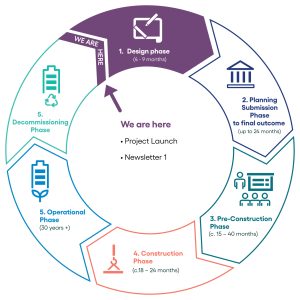
It can take six to 10 years from project initiation to operation of a typical battery storage project. This is due to the sequential process of designing a project, obtaining planning permission, securing project finance and construction.
Sometimes, for reasons beyond our control, timelines may change. If this should happen, we will keep the community informed through letter-drops and via the project website.
-
- Community engagement: August 2026 to Nov/Dec 2026
- Planning submission: Nov/Dec 2026
- Planning decision: Jan/Feb 2027
- Grid Connection Application: March 2027 (Assuming project receives a planning grant with no appeal)
- Construction Early 2030s
16. Can you explain the planning process?
The Lettermore team will consult with An Coimisiún Pleanála (ACP) to confirm whether Lettermore Energy Storage will be considered a Strategic Infrastructure Development project (SID). If it is determined to be a SID project, then we will be required to submit the application to ACP. If not, the application will be made to the local planning authority, Donegal County Council.
Our expectation is that this will not be considered a SID project, but we will advise the community of any final decision by ACP.
In advance of any planning application being submitted, an advert will be placed in the local newspaper, and notifications will be uploaded to the dedicated project website.
We also place site notices locally and inform everyone who has shared their contact details during the community engagement process.
When a planning application is submitted and validated, the planning documents, including all environmental surveys and drawings, will be uploaded to the project website www.lettermoreenergystorage.ie for public viewing.
The full planning application, all supporting documents and drawings will also be available on (Donegal County Council's website) the relevant planning authority's website (www.donegalcoco.ie). All our planning applications are open for you to review and provide feedback.
17. How can I be kept up to date?
The community engagement programme includes project newsletters and this website will also be regularly updated.
You can email, call or text our community engagement manager Shane Lowry and ask any questions you may have and if you like, request to be kept up to date.
Call Shane: 087 210 5889
Email: lettermore@futurenergyireland.ie
Alternatively, you can send us a message via the Contact Us section of the website www.lettermoreenergystorage.ie
Postal address: Shane Lowry, Lettermore Energy Storage, c/o, FuturEnergy Ireland, 27/28 Herbert Place, Dublin 2. D02 DC97